
Student Name
DB-FPX9801
Capella University
Professor Name
submission Date
Pre-Implementation Conference Call Presentation
Slide 01
Hello! I’m the person _______, and I’m here to do a pre-implementation conference call presentation on this subject: adaptive leadership practices to support digital transformation in mid-size technology companies.
Slide 02
Introduction
Digital transformation is key to the competitiveness and efficiency of operations. A unique set of digital challenges and digital transformation challenges exists for mid-sized tech businesses (Ameen et al., 2022). Some of the common barriers are resistance of employees to change and limited resources (Ramesh & Delen, 2021). Many organizations are not digitized and don’t have up-to-date technological infrastructure (Hojnik & Huđek, 2023). Just a handful view digital transformation as a principal strategy. The application of adaptive leadership can increase innovation and decrease employee resistance (Chughtai et al., 2023). Project leaders discuss the importance of adaptive leadership in any tech company’s success in transforming.
Slide 03
Statement of the Problem
Problem Statement
The overall business challenge is that most organizations cannot manage the complex digital transformational technologies, and as a result, their operations remain less efficient, employees lose engagement, and fail to achieve their strategic goals (Ameen et al., 2022).
US technology mid-sized companies often suffer from a lack of competitiveness due to the difficulty of leaders in implementing desired leadership approaches to deal with employee resistance to digital transformation and prevent growth opportunities from falling through the cracks (Skare et al., 2023).
Purpose Statement
The qualitative inquiry project aims to understand the ideas of the US middle enterprises’ leaders in the field of leadership strategies that can be used to overcome employee resistance to digital transformation technologies.
Gap in Practice
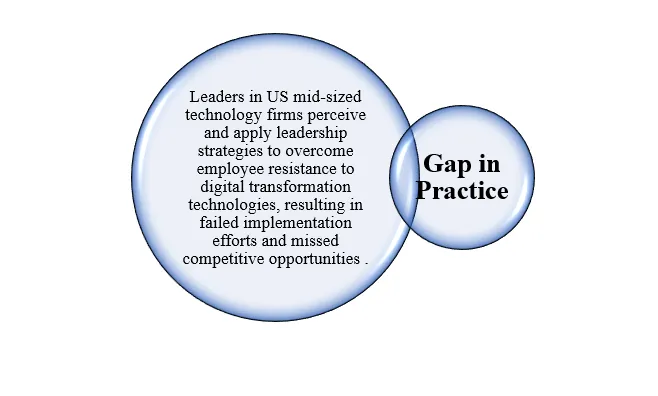
The disconnect is that little is known about how leaders at US mid-sized technology companies see and engage in leadership strategies to overcome resistance to digital transformation technologies and how this contributes to unsuccessful implementation efforts and the loss of competitive opportunities (Errida & Lotfi, 2021).
Slide 04
Slide 05
Theory(s) Supporting Research
The theoretical lens used to view the study is that of transformational leadership theory, which looks at how leadership can impact organizational change and innovation. Transformational leadership theory addresses how leadership contributes to change in an organization. Burns (1978) added a new concept of leadership around a shared set of values, motivation, and purpose. Bass built on this work of Burns by introducing observable leadership behaviors (Bass, 1985). Core transformational behaviors include the four 4I dimensions (idealized influence, inspirational motivation, intellectual stimulation, individualized consideration) (Bass & Avolio, 1994). Idealized influence has been defined in terms of leaders as ethical role models and trust (Burns, 1978). Inspirational motivation is about calling forth a common vision and stirring all employees to action (Peláez et al., 2023).
The intellectual stimulation promotes innovation and challenges the status quo (Burns, 1978; Schiuma et al., 2024). Doing this involves mentoring and coaching as well as learning/teaching to the individual’s development needs (Trenerry et al., 2021). Adaptive thinking towards technological change is facilitated by transformational leadership (Rahi et al., 2021). The theory is especially applicable in dynamic business environments where digital transformation is essential and provides a competitive edge. The theory advocates digital literacy and readiness to change in mid-sized businesses. Virtual teams and digital innovation were added to the theory. Peláez et al. (2023) agreed with the impacts on success with digital transformation. In the context of technology innovation management, correlations between transformational behaviors and innovation outcomes are found to be strong among modern scholars (Schiuma et al., 2024). Leadership behaviors are a factor in terms of the adoption of digital tools and technologies. Transformational leadership is very appropriate for managers to lead mid-size businesses in transformation.
Slide 06
Methodology
Research technique is most suitable with a generic qualitative approach, which can reveal the perspectives of leadership in the digital transformation context in regard to adaptive practices. According to Sekar & Bhuvaneswari (2024), it is a type of qualitative study that can be analyzed as the subjective perception of each individual with the study. As the aim of the present study is to reveal the complex, “lived” experiences of the participants related to the context, generic qualitative inquiry has been used as a method appropriate to leadership studies (Fischer & Guzel, 2022). The way is flexible, and it can allow them to analyze all the adaptive leadership practices (Olatunde & Olenik, 2021). This is a result of research aiming/methodology convergence in which the leadership strategies in technological change processes and content have been nuanced.
Slide 07
Sample
The leadership, by engaging in the digital transformation of the organisations, will be targeted for the study. Some of the respondents are CEOs, CTOs, and digital transformation managers (Campbell et al., 2020). The participants will build on the leadership generalization and understanding amongst the different industries. The respondents will be selected through purposive sampling as they have a first-hand experience in DT. The data collection will include 10 participants to make the data collection process manageable, and simultaneously provide profound in-depth in the behavior of participants.
Slide 08
- Would you share a little bit about what you do now and how much experience you have in leadership within the tech industry?
- What is your organisation’s experience with digital transformation over the last few years?
- What kinds of leadership strategies have you seen work best in overcoming employee resistance to the use of digital transformation technologies?
- Have you ever experienced a scenario in which you found a way to make an electronic effort work through an employee’s strong resistance? How did you plan to conduct your project?
- What are some indicators of employee reluctance to new technologies, and what do you do about them?
- How do you communicate when implementing new digital technologies with your team?
- What do you do to engage or include employees in decision making about digital transformation efforts?
- How do you establish trust with workers who aren’t open to technology change?
- What do you think should be the most important leadership behaviors to inculcate a culture of digital innovation?
- What about managing the pace at which digital solutions are introduced and the comfort and readiness of employees?
Slide 09
- How do mentoring and/or coaching fit into your strategy for helping employees get comfortable using new technologies?
- What particular issues are technology companies of a middle size in the process of digital transformation going through that are not also present in larger organizations?
- What happens in case of a shortage of resources in a company of medium size, does it influence your leadership related to digital transformation?What organisational setups or processes have you had in place to enable successful digital adoption?
- Reflecting on it, what are the most significant leadership actions for successful digital transformation?
- What are some pitfalls or best practices you learned with regards to challenges like this?
- What are your indicators of leadership strategies being effective when dealing with employee resistance?
- What else do you feel other leaders should know about your leadership approach to digital transformation?
- What would your three best tips be to leaders of other similar organizations facing employee pushback for the adoption of digital changes?
Slide 10
Data Collection
The data collection method to be used in the suggested research is a semi-structured interview to elicit the views of the leadership. The interviews will be virtual in order to ensure the participation of people from different geographical areas. Interview guides will be developed that incorporate some structure and flexibility to the questions being asked in line with the literature (Henriksen et al., 2021). Data will be collected via audio- then the data will be transcribed and the actual data analyzed. Thematic analysis will also be used as the main method for analysing the data, in order to work out the patterns from the interviews that will be carried out. The interviews will be 30–90 minutes in duration to allow time for participants to maximize their responses without fatiguing them (Chirumalla et al., 2025). Of course, reliability will be a major concern and, as such, pilot testing of the interview process will occur.
Slide 11
Instrumentation
There are open-ended questions on the instrumentation that will enable the participants to probe into the leadership practices. Questions will be created to test leadership, issues, management, and decision-making aspects. Seeking teamwork and organisational culture, the interview guide will also include questions (Campbell et al., 2020). In order to enhance the answers, the participants should be enabled to discuss the answers through the use of clarification prompts. First, the interview will begin with background questions with a view to creating a friendly environment before proceeding with the leadership questions. The guide will be further developed through pilot testing to refine the guide and make it clearer and more relevant.
Slide 12
Data Collection Plan
In order to allow the respondent to give a detailed description of the experiences, the main research instrument to use is a semi-structured interview (Olatunde & Olenik, 2021). Initially, interviews will take place at the convenience of the participant so as to be comfortable and get involved completely to the utmost level. Following this will be the structured interview guide, semi-structured to discuss the content and provide flexibility and depth (Henriksen et al., 2021). Thirdly, there will be background questions for gaining rapport and context. The main questions will focus on the style of leadership, issues faced, and communication. The questions will be followed by clarification prompts, which aim to further elaborate participants’ responses (Chirumalla et al., 2025). Lastly, interviews will be recorded on an audio tape and later, for accuracy and analysis, shall be transcribed verbatim.
Slide 13
Data Analysis Plan
To achieve a strong understanding of the participant’s response, the first transcripts will be read multiple times. Second, manual data coding will be done in order to find common themes and concepts of leadership. Thirdly, codes will be further classified into style, culture, and communication (Campbell et al., 2020). Fourthly, leading the interpretation of leadership experiences and meanings will follow the principle of thematic analysis. Upon completion, noticeable trends and/or differences across cases will be highlighted (Joseph & Sengul, 2024). Themes and insights will then be developed in an iterative process, reviewed, and with feedback from colleagues.
Slide 14
Conclusion
Qualitative methodology was used to gain rich, in-depth data on leadership experiences and strategies. Participants were purposively selected as having pertinent leadership knowledge and experiences. Semi-structured interviews allowed an open, reflective response and provided good guidance for the interview. The process of data collection was done in steps so as to encourage the full participants’ involvement and comfort while providing high quality of data. This involved identifying patterns & meanings from complex data on leadership through thematic analysis. Results gave feedback to the management on leadership development, communication, and change. Future studies could increase the number of participants for more generalizability.
References
Ameen, N., Choudrie, J., Jones, P., & Anand, A. (2022). Innovative technologies and small-medium sized enterprises in times of crisis. Information Systems Frontiers. https://doi.org/10.1007/s10796-022-10353-7
Bass, B. M. (1985). Leadership and performance beyond expectations. Free Press.
Bass, B. M., & Avolio, B. J. (1994). Improving organizational effectiveness through transformational leadership. Sage.
Burns, J. M. (1978). Leadership. Harper & Row.
Campbell, S., Greenwood, M., Prior, S., Shearer, T., Walkem, K., Young, S., Bywaters, D., & Walker, K. (2020). Purposive sampling: Complex or simple? Research case examples. Journal of Research in Nursing, 25(8), 652–661. https://doi.org/10.1177/1744987120927206
Chirumalla, K., Oghazi, P., Nnewuku, R. E., Tuncay, H., & Yahyapour, N. (2025). Critical factors affecting digital transformation in manufacturing companies. International Entrepreneurship and Management Journal, 21(1). https://doi.org/10.1007/s11365-024-01056-3
Chughtai, M. S., Syed, F., Naseer, S., & Chinchilla, N. (2023). Role of adaptive leadership in learning organizations to boost organizational innovations with change self-efficacy. Current Psychology, 1(20), 1–20. https://doi.org/10.1007/s12144-023-04669-z
Errida, A., & Lotfi, B. (2021). The determinants of organizational change management success: Literature review and case study. International Journal of Engineering Business Management, 13(1), 1–15. https://doi.org/10.1177/18479790211016273
Fischer, E., & Guzel, G. T. (2022). The case for qualitative research. Journal of Consumer Psychology, 33(1). https://doi.org/10.1002/jcpy.1300
Henriksen, M. G., Englander, M., & Nordgaard, J. (2021). Methods of data collection in psychopathology: The role of semi-structured, phenomenological interviews. Phenomenology and the Cognitive Sciences, 21(2). https://doi.org/10.1007/s11097-021-09730-5
Hojnik, B. B., & Huđek, I. (2023). Small and medium-sized enterprises in the digital age: Understanding characteristics and essential demands. Information, 14(11), 606. https://doi.org/10.3390/info14110606
Joseph, J., & Sengul, M. (2024). Organization design: Current insights and future research directions. Journal of Management, 51(1), 249–308. https://doi.org/10.1177/01492063241271242
Olatunde, O. A. A., & Olenik, N. L. (2021). Research and scholarly methods: Semi‐structured interviews. Journal of the American College of Clinical Pharmacy, 4(10), 1358–1367. https://doi.org/10.1002/jac5.1441
Olatunde, O. A., & Olenik, N. L. (2021). Research and scholarly methods: Semi‐structured interviews. Journal of the American College of Clinical Pharmacy, 4(10), 1358–1367. https://accpjournals.onlinelibrary.wiley.com/doi/full/10.1002/jac5.1441
Peláez, R. M., Brust, A. O., Rivera, S., Félix, V. G., Ostos, R., Brito, H., Félix, R. A., & Mena, L. J. (2023). Role of digital transformation for achieving sustainability: Mediated role of stakeholders, key capabilities, and technology. Sustainability, 15(14), 11-32 https://www.mdpi.com/2071-1050/15/14/11221
Rahi, S., Alghizzawi, M., Ahmad, S., Munawar Khan, M., & Ngah, A. H. (2021). Does employee readiness to change impact organization change implementation? Empirical evidence from emerging economy. International Journal of Ethics and Systems, ahead-of-print(ahead-of-print). https://doi.org/10.1108/ijoes-06-2021-0137
Ramesh, N., & Delen, D. (2021). Digital transformation: How to beat the 90% failure rate? IEEE Engineering Management Review, 49(3), 1–1. https://doi.org/10.1109/emr.2021.3070139
Schiuma, G., Santarsiero, F., Carlucci, D., & Jarrarb, Y. (2024). Transformative leadership competencies for organizational digital transformation. Business Horizons, 67(4), 8–12. https://doi.org/10.1016/j.bushor.2024.04.004
Sekar, D., & Bhuvaneswari, M. (2024). Exploring the depths: Qualitative research in psychology. Www.igi-Global.com; IGI Global. https://www.igi-global.com/chapter/exploring-the-depths/337060
Skare, M., Obesso, M., & Navarrete, S. R. (2023). Digital transformation and European small and medium enterprises (SMEs): A comparative study using digital economy and society index data. International Journal of Information Management, 68, 102594. https://doi.org/10.1016/j.ijinfomgt.2022.102594